Rolex made the GMT-Master with Pan Am so that crews flying across oceans could keep two times at once. The idea hasn't changed since: a fourth hand that goes round once a day, and a bezel marked in 24 hours. What changes from one reference to the next is small, which is what makes them fun to learn.
Pick a reference on the timeline. The drawing keeps your own time, with the 24-hour hand on GMT, as the name promises.
An illustration, not a real watch: it's here to show the bezel colours, the hands and what changed.
6542
1954–1959The Pan Am watch
- Made with Pan Am so its pilots and navigators could track two time zones: local time on the usual hands, home time or GMT on a red hand that goes round once a day, read off a 24-hour bezel. Red for the day hours, blue for the night.
- 38 mm, steel at first, later also 18k gold with a brown bezel and brown dial.
- The bezel insert was Bakelite with numerals painted in radium. It cracked easily, so within a few years Rolex switched to aluminium.
- No crown guards yet. Pussy Galore, a pilot, wears one in Goldfinger (1964), which is where the nickname comes from.
1675
1959–1980Twenty years of small changes
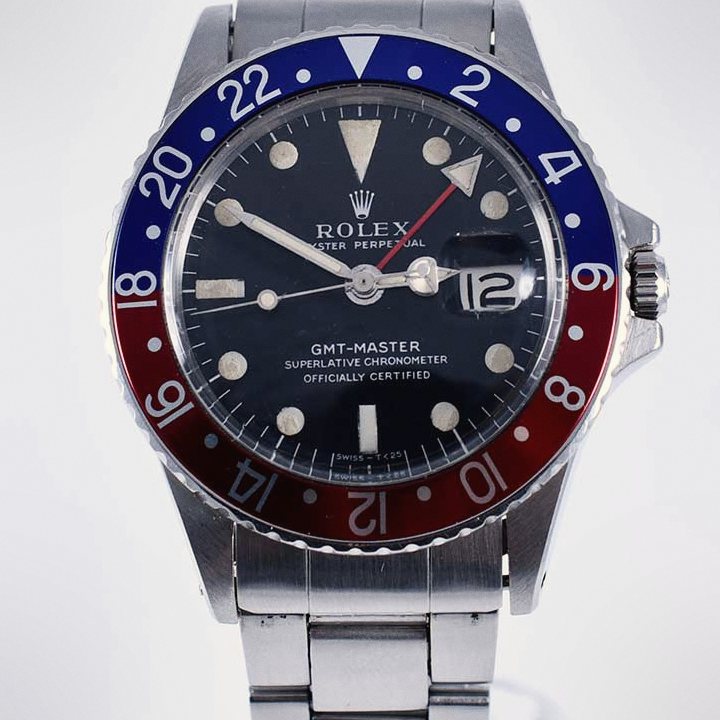
- A bigger 40 mm case with crown guards, pointed on the first ones and rounded from the mid-sixties. Aluminium bezel inserts from the start.
- Glossy gilt dials (gold print) until about 1966, then matte dials with white print. The gilt dials have a printed ring around the minute track, the chapter ring. Later dials drop it, and the minute marks run to the edge.
- The earliest dials say only “Officially Certified Chronometer”, and “Superlative” came a few years in. The lume moved from radium to tritium in the early sixties. The 24-hour hand has a small arrow at first, a bigger one later.
- Some red inserts from around 1966–72 have faded to pink: collectors call them Fuchsia. A dial that has faded to brown is called tropical.
- The all-blue Blueberry insert is a small mystery: a special order, or a service part? Nobody has shown which.
- The 1675/3 in steel and gold has a brown bezel: the Root Beer. A steel-and-gold GMT is also called the Clint Eastwood, after the one he wore in Firefox (1982).
16750
1980–1988Quickset date
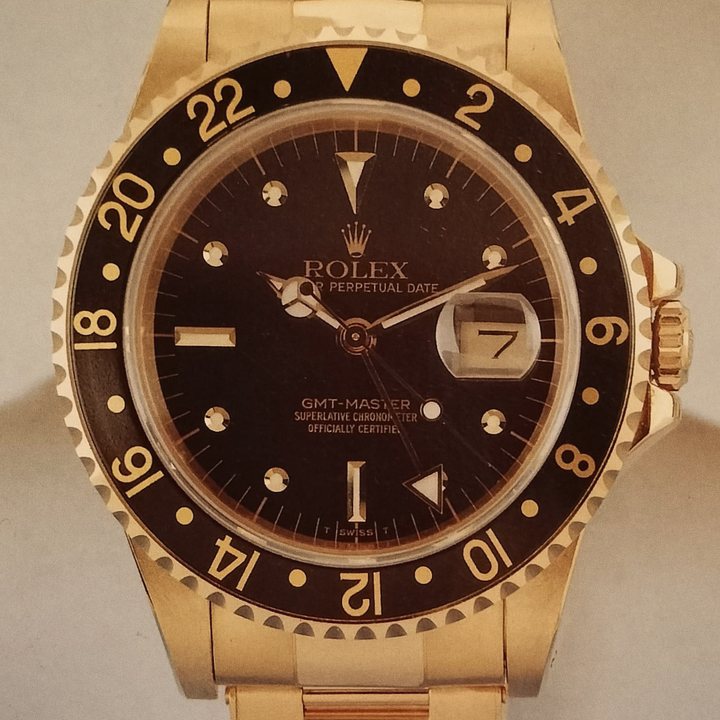
- The second-to-last GMT-Master. A faster movement, calibre 3075, and a quickset date: the date moves by the crown, no more winding the hands through midnight.
- Matte dials at first. Like the Submariners and Explorer IIs of the time, some have cracked into a fine web: a spider dial. From about 1984 the dials are glossy, with the markers set in white gold.
- Still an acrylic crystal.
16760
1983–1988Fat Lady, the first GMT-Master II
- The big step: the hour hand can be set on its own, in one-hour jumps, without stopping the watch (calibre 3085). Until now you could only turn the bezel.
- The extra works made the case thicker, hence the Fat Lady, or Sophia Loren.
- The first red-and-black Coke bezel, an alternative to the Pepsi, and a sapphire crystal.
- Sold alongside the GMT-Master 16750, which stayed as the simpler, cheaper option.
16700
1988–1999The last GMT-Master
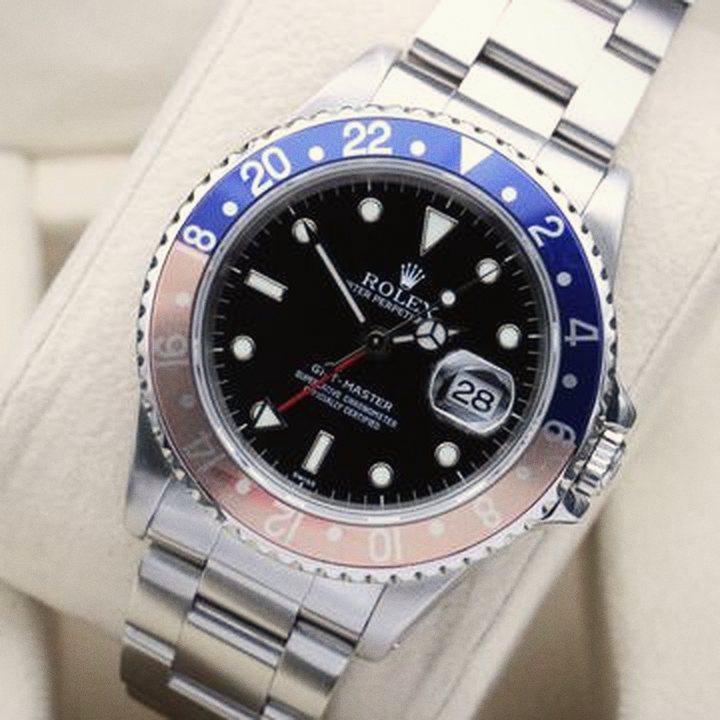
- Calibre 3175 and a sapphire crystal, but no independent hour hand: the GMT-Master without the II.
- Pepsi or black bezel. When it ended in 1999, so did the GMT-Master name, after 45 years.
16710
1989–2007The long one
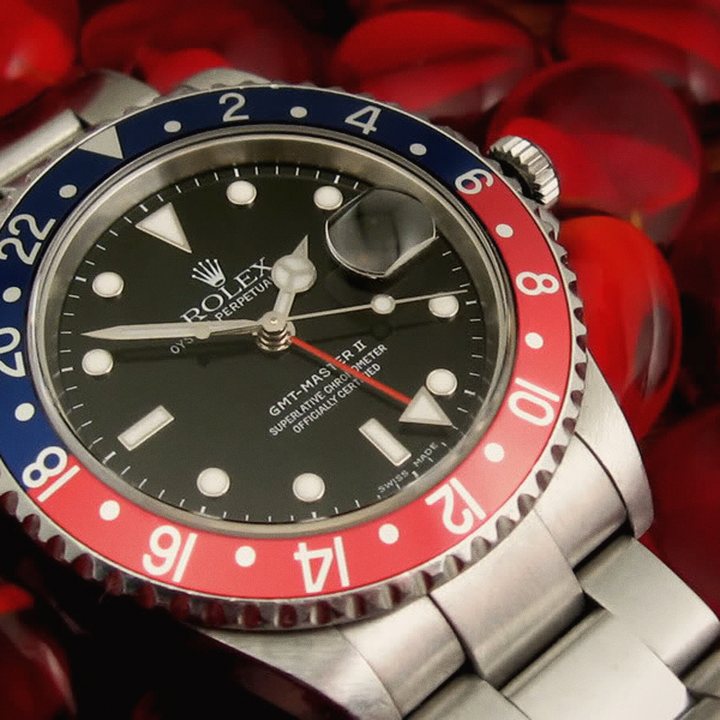
- Slimmer than the Fat Lady, with calibre 3185 (3186 in the last couple of years). Made for eighteen years, so there are plenty around.
- Pepsi, Coke or all black, and the inserts swap, so many owners had all three.
- The lume dates it: tritium until 1998, then Luminova, then Super-LumiNova from about 2000.
- The last steel Pepsi for eleven years.
116710
2007–2019Ceramic
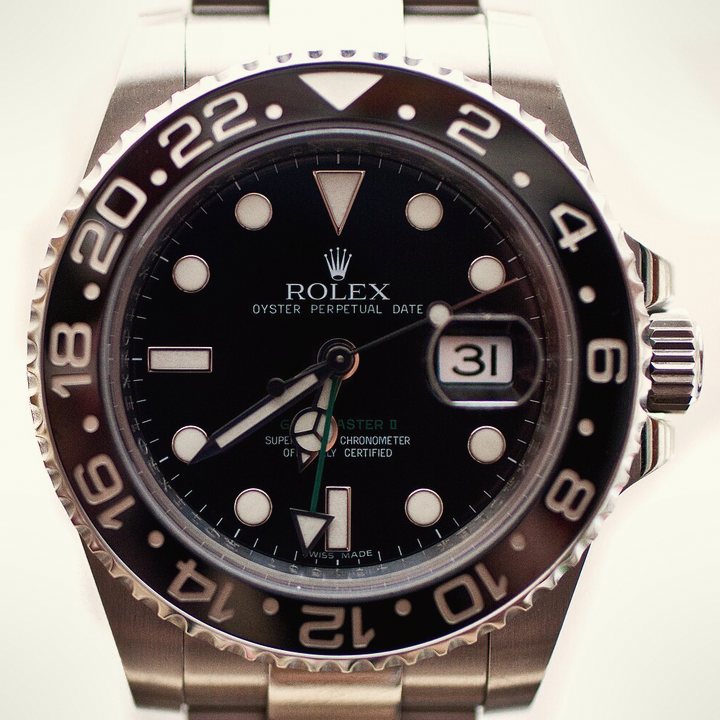
- A ceramic bezel insert (Cerachrom) that doesn't fade or scratch. It came first on the yellow-gold 116718LN in 2005, for the 50th anniversary.
- Calibre 3186 with about 48 hours of reserve, bigger “Maxi” markers in Chromalight, which glows blue, and a green 24-hour hand on the black 116710LN.
- Two colours in one piece of ceramic were hard, and red the hardest. So in 2013 came the blue-and-black Batman, the first two-colour ceramic bezel, while Rolex made no steel Pepsi at all.
- The Pepsi came back in ceramic in 2014, but only in white gold (116719BLRO), the first white-gold GMT. The usual story is that the red was so hard to get right that Rolex kept it to a small, expensive run.
126710
2018–todayThe Jubilee is back
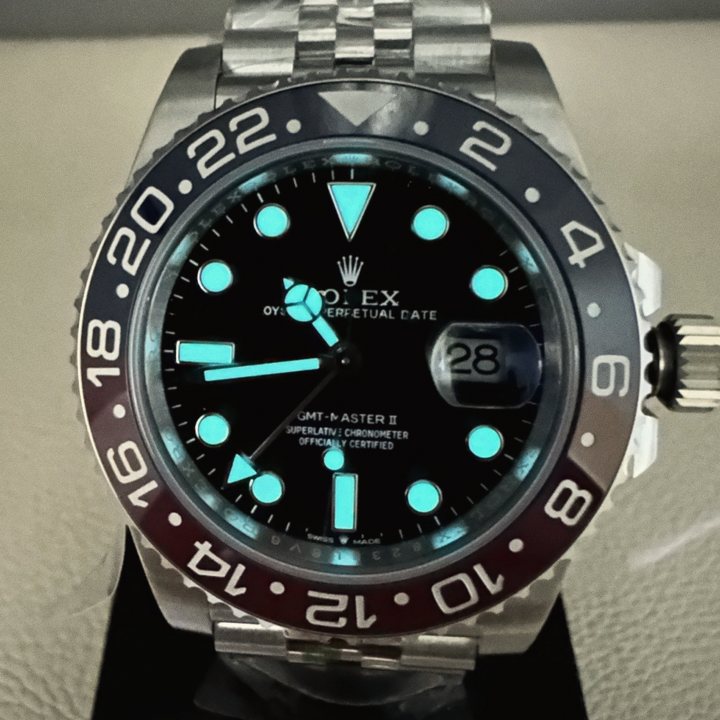
- Calibre 3285 with 70 hours of reserve. The Pepsi returned in steel in 2018 and the Batman moved to this movement in 2019, both on the five-link Jubilee bracelet, a nod to the seventies. The Oyster came back as an option in 2021.
- 2018 also brought the Root Beer back, in Everose gold (126711CHNR in steel and gold, 126715CHNR in solid gold).
- 2022: the green-and-black Sprite (126720VTNR), with the crown and date on the left. 2024: grey and black (126710GRNR). 2025: a white-gold Sprite with a green ceramic dial, Rolex's first.
- In spring 2026 the steel Pepsi quietly left the catalogue. Rolex didn't announce it.
Two time zones, two ways
On the GMT-Master the 24-hour hand moves with the others. You set it to home time and turn the bezel to read anywhere else. The GMT-Master II lets you move the hour hand on its own, in one-hour jumps, while the watch runs: set it to wherever you've landed and the 24-hour hand keeps home. Turn the bezel as well and you have a third zone.
If you're buying one
Two things I wanted to know when looking at used ones. First, the movement. The ceramic watches from 2007 to 2019 have the 3186 with about 48 hours of reserve, and the 126710 references from 2018 on have the 3285 with 70. A Batman on an Oyster bracelet can be either, so go by the reference, not the bracelet.
Second, the lume. Look at the bottom of the dial: “T Swiss T” or “Swiss – T<25” means tritium, which has mostly stopped glowing by now. “Swiss” alone is Luminova, from about 1998 to 2000, and “Swiss Made” is Super-LumiNova, which glows green. Everything ceramic has Chromalight, which glows blue.
| Ref. | Years | Calibre | Own hour hand | Lume |
|---|---|---|---|---|
| 6542 | 1954–59 | 1036, 1065/1066 | no | radium |
| 1675 | 1959–80 | 1565, then 1575 | no | radium, then tritium |
| 16750 | 1980–88 | 3075 | no | tritium |
| 16760 | 1983–88 | 3085 | yes | tritium |
| 16700 | 1988–99 | 3175 | no | tritium, then Luminova |
| 16710 | 1989–2007 | 3185, then 3186 | yes | tritium, then Super-LumiNova |
| 116710 | 2007–19 | 3186 | yes | Chromalight |
| 126710 | 2018– | 3285 | yes | Chromalight |


